
Trace Johnson County Former Owners
The backward chain starts with the most recent deed. Its grantor becomes the next owner to investigate. Search that person as a grantee in an earlier period, then repeat the pattern. Hold the chain to the same tract with the legal description and the book and page reference, since names and addresses drift over time.
| Transfer stage | Grantor to grantee | Deed event | Reference to capture |
|---|---|---|---|
| Newest relevant record | Latest seller to current grantee | Warranty, quitclaim, estate, foreclosure, or other deed | Instrument number or book/page plus legal description |
| Next earlier record | That seller's seller to that seller | Earlier acquisition instrument | Book/page, instrument and record dates, parcel description |
| Before the web cutoff | Earlier parties in the reverse index | Clerk deed book or permanent index | Volume/page and exact indexed spelling |
Build a timeline, not a list of guessed owners. Enter only names read from the relevant Johnson County records. Same-name people, initials, inherited interests, and entity names can all forge a false link.
Johnson's 1987 Online Threshold
The GSCCCA index lists Johnson County with a good-from date of January 1, 1987. The search page also carries a generic Central Indexing notice beginning January 1, 1990. Both dates matter. The county row is the stronger local clue. But the clerk should confirm any instrument that falls near that boundary.
The cutoff marks where online indexing begins, not where ownership begins. Deed books and their indexes are permanent records under Georgia's retention schedule. Once a chain reaches before 1987, the work moves to the clerk's books. Archival finding aids come next as needed.
Older-chain limit. The inspected Johnson index reaches 1987; seek earlier owners in clerk deed books, permanent indexes, and archival microfilm.
Johnson Names Need Two Roles
GSCCCA's Party Type control offers All Parties, Grantor, and Grantee. Search the prior owner as grantee to find that party's acquisition. Then read the grantor from the earlier conveyance. Separate searches also expose spelling or indexing differences that an all-parties result can hide.
Use instrument filters with care. A deed from estate, quitclaim deed, foreclosure deed, sheriff's deed, tax sale deed, or trustee's deed can each form a chain event. Security deeds, assignments, liens, and releases may matter, but they are not ordinary owner-to-owner transfers.
The GSCCCA Johnson County name-search form is the online starting screen for prior owners.
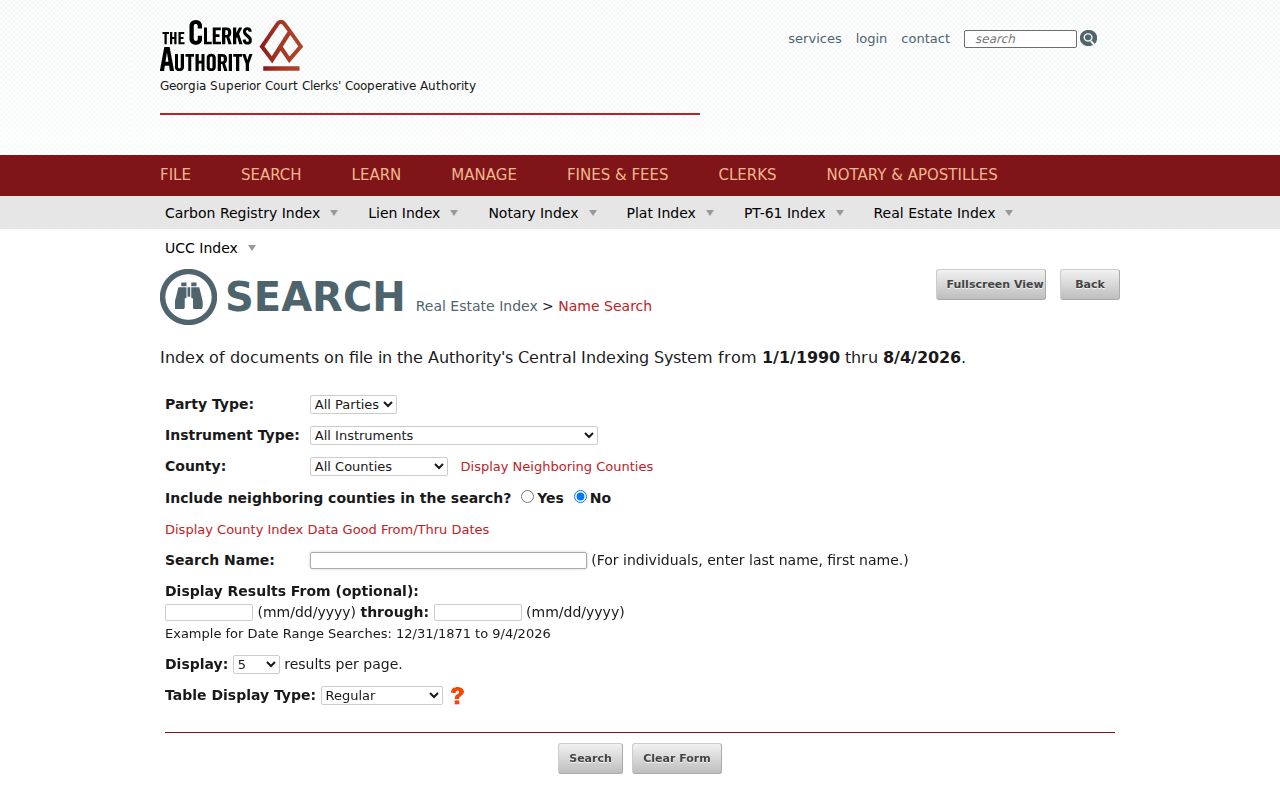
The search form supports separate grantor and grantee work. That split matters when tracing previous owners back one transfer at a time in Johnson County property records.
Reconstruct Johnson's Chain Backward
Begin after identifying the current deed. Record the exact names and land description before taking the first backward step. Johnson is county code 83 in GSCCCA, and date filters, instrument type, and party role all help when a surname returns a crowd of Johnson County records.
- Find the current owner's acquisition deed and verify its legal description against the parcel.
- Write down the grantor, deed type, record date, and book/page or document number.
- Search that grantor as grantee in an earlier range, then compare the land description again.
- Repeat to the online boundary, then continue in the clerk's reverse index and deed books.
- Grantor
- The party conveying an interest.
- Grantee
- The party receiving an interest.
- Chain of title
- The connected sequence of transfers for the same land.
- Reverse index
- An index used to trace parties through the opposite role.
- Quitclaim deed
- A transfer of the grantor's claimed interest without warranty-deed assurances.
Move Johnson Research into Books
For a pre-1987 link, call the Johnson County Clerk of Superior Court at 478-864-3484. Ask for the right grantor and grantee index. Ask for the deed book by party and approximate year. Official pages list different post office boxes and slightly different hours. Confirm the mailing route first.
The county publishes no complete deed-book list online. It also posts no local copy-fee schedule. Treat neither as established fact. The clerk holds the original records and the certified-copy route. The Georgia Archives points to county microfilm and reading-room access for older material.
The Archives notes that pre-1900 county records may be located through County Records on Microfilm aids. FamilySearch offers another path. Staff can pull a limited number of boxes in advance. The Archives does not provide distance research service. Capture the collection, reel, volume, page, and image references. Each link can then be reproduced later.
Plats can clarify a subdivision, district, land lot, or lot reference when names stall. GSCCCA's plat form includes county, name, district, land lot, and dates. The county publishes no exact historic Johnson plat-book run, so the clerk remains the fallback for parcel questions.
Johnson Court Minutes Add Clues
FamilySearch catalogs Johnson County court minutes from 1859 through 1903. Books A and B cover 1859 to 1886 on film 432720, Books C and D cover 1886 to 1896 on film 432721, and Book E covers 1896 to 1903 on film 432722. Their DGS numbers run from 8656020 through 8656022.
These minutes are not a deed index. They can point to estate actions, commissioners, petitions, and orders that explain a broken chain. Images may require a free account or a FamilySearch Center. Probate Court may hold related wills, appointments, inventories, or petitions.
An estate changes the language of a chain. A deed may name an executor, administrator, estate, heir, or commissioner rather than the decedent as an ordinary grantor. Search those variants along with deed-from-estate records. A probate order explains authority, but the later deed connects that authority to the land.
Note: A probate heir did not necessarily receive title; connect the estate action to a recorded transfer.
Kite Names Shift in Johnson Records
Kite's name preserves a simplified spelling of Shaderick Kight. That history teaches a useful index lesson: place and family spellings shift. Search both Kite and Kight when context supports it. But never alter the spelling inside a source transcript.
An early deed may also lack a modern street address. Use the district, land lot, subdivision, lot and block, or metes-and-bounds text instead. A place-name clue locates candidates; the legal description keeps the chain on the same property.
Adrian Can Split a Johnson Chain
Adrian sits astride the Johnson and Emanuel County line. Its post office label tells you nothing about which clerk holds the deed. The odd Z-shaped boundary traces back to an old Ohoopee River bridge dispute. Near that line, confirm the legal county. Do this before you decide a missing owner is a records gap.
GSCCCA offers an include-neighboring-counties toggle. Use it to surface candidates, then keep each county's instruments separate. An Emanuel deed never becomes a Johnson deed just because the mailing address reads Adrian.
Johnson Ownership Beyond Web Records
Johnson County was formed in 1858 from parts of Emanuel, Laurens, and Washington Counties. A chain that reaches back toward formation may land in a predecessor county. The earliest surviving Johnson deed volume has no verified online inventory. Nor does a full historic tax-roll run. So lean on clerk indexes, Archives microfilm guides, and exact citations.
Historic newspapers help too. They carry legal notices, estate notices, sheriff's sales, and land-sale ads. The Johnson Journal is the legal organ, and Georgia Historic Newspapers covers older issues. These explain events but never replace deeds. For the present name, use the current-owner check. For a copy, take the deed-records route.
A tract recorded at county formation may sit under an earlier county name. Work backward through Johnson's books until the property description itself directs that move. Never jump counties on a surname alone. Boundary calls, adjoining owners, waterways, district numbers, and acreage can all survive a jurisdiction change. So preserve every one.
Old tax rolls, cemetery sources, and newspapers can corroborate where someone lived. They can also show when a death transfer fell. None of them proves ownership by itself. Keep each source in its lane. Deeds handle conveyance, probate files carry estate authority, plats hold mapped divisions, and newspapers provide notice. When dates conflict, label the conflict until the record resolves it.
Keep a full research log. Note failed searches alongside the hits. Record the spelling, role, date span, county, and instrument filters you used. That discipline stops you from repeating a dead end. It also reveals when a missing link reflects an index variant. That variant matters more than a missing deed. Former owners stay linked only when the land description and transfer record agree.
Lawful use. Trace former owners for house history, estate work, or land diligence, never to track, harass, intimidate, or harm a living person.