
Types in Johnson County Deed Records
The Clerk of Superior Court maintains Johnson County deed records, and GSCCCA hosts the index. Every deed records a transfer between two parties. Its type tells you what kind of transfer occurred. Some filings do more than move ownership, though. Liens, releases, easements, and plats all attach to land in different ways. Read the instrument itself before trusting the label alone.
| Deed Type | What It Does | Common Use |
|---|---|---|
| Warranty deed | Conveys the stated property with deed warranties | Ordinary sale transfer |
| Quitclaim deed | Conveys whatever interest the grantor has | Family transfer or interest cleanup |
| Deed from estate | Transfers under estate authority | Probate-linked succession or sale |
| Foreclosure or sheriff's deed | Records a sale through a legal process | Distressed-property chain |
| Tax-sale deed | Records a tax-sale conveyance | Delinquent-tax trail |
A security deed reflects financing, not a simple sale. A lien puts a recorded claim on the property. A release or cancellation clears an earlier filing, and an easement grants someone a defined use of the land. Johnson County property records often mix all of these on one parcel. Keep each instrument's purpose straight as you search.
Johnson Deed Search Fields
The GSCCCA name search gives you precise controls for Johnson County deed records. Pick Johnson County, code 83, first. Then enter the party. Individuals go in as last name, first name. A role filter separates grantors from grantees, which narrows results fast when a common name appears.
| Field | Choices or format | Why it matters |
|---|---|---|
| Party Type | All, Grantor, Grantee | Sets the person's role |
| Instrument Type | Deeds, liens, releases, easements, estate records, and more | Narrows the filing class |
| County | Johnson, code 83 | Sets the recording jurisdiction |
| Neighboring counties | Yes or no | Helps with Adrian's split-county geography |
| Name | Last name, first name | Locates indexed parties |
| Date range | mm/dd/yyyy | Controls common or short names |
The form also lets you set results per page and table display. Matched entries will show party, role, document type, date, book and page, and image status. The Johnson County deed search form displays these controls directly.
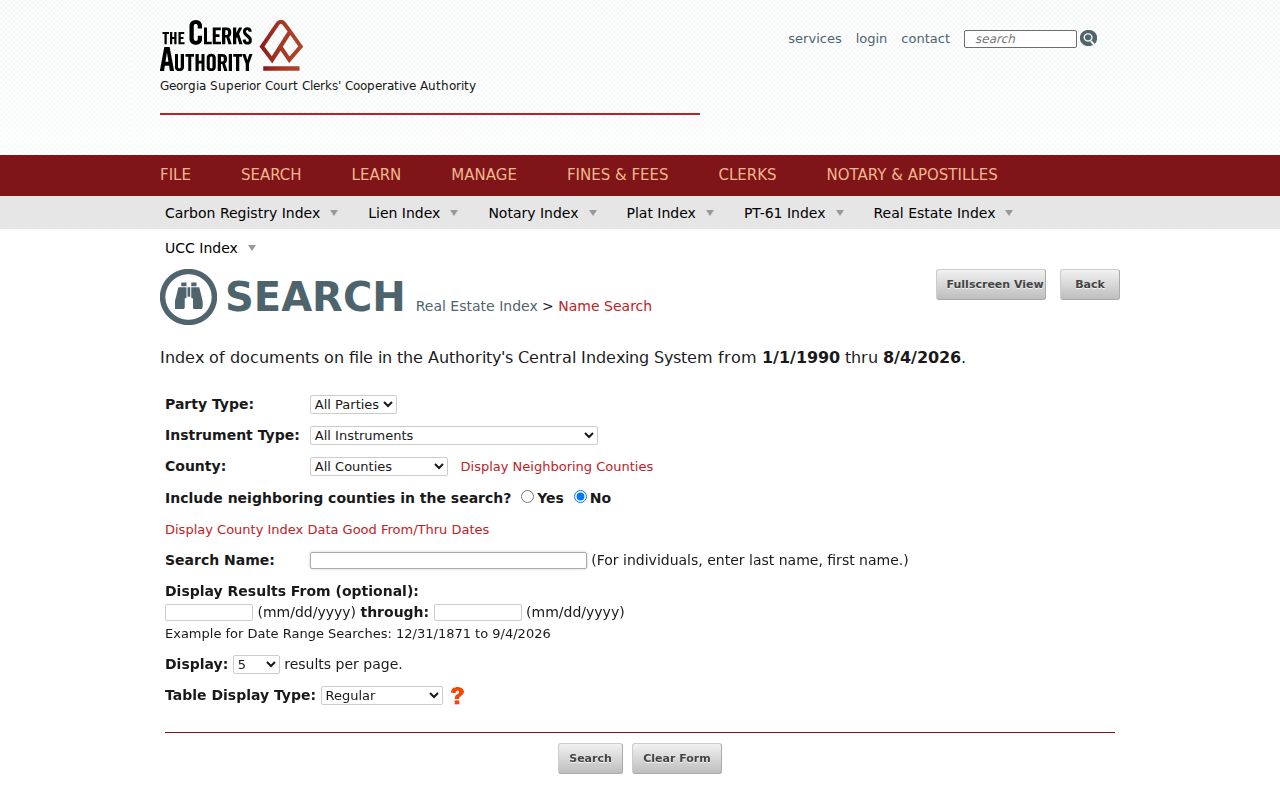
The search form is only the front door. After an index match, the recorded deed itself is the document to inspect.
Johnson County's 1987 Starting Line
Johnson County real-estate indexing on GSCCCA runs from January 1, 1987 forward. The good-through date advances as documents are added. The general public search also lists Central Indexing beginning January 1, 1990. That is three years later than the county's own start. That gap matters. It shapes what you can expect for an older chain of title. Confirm any deed near either boundary with the clerk before relying on it. And the start date does not mean older deeds disappeared. Deeds recorded before 1987 still exist in deed books, older indexes, and microfilm. Staff at the clerk's office can help you reach them.
Note: The 1987 county row and generic 1990 notice describe index displays, not the date Johnson County began recording deeds.
Johnson Security Deeds and Releases
Ownership deeds are just one thread of the land trail. GSCCCA indexes security deeds, liens, materialmen's liens, easements, boundary-line agreements, rights of way, restrictive declarations, powers of attorney, court orders, and releases. Any of these can complicate a parcel's record. It may look more tangled than a simple string of sales. When a security deed or lien appears, look for its matching cancellation or release. Compare party names, dates, and legal descriptions. Same-name filings do not always involve the same tract. A release may clear one instrument while other claims stand. For a legal opinion on encumbrances, get qualified title help.
Johnson County Grantor-Grantee Chain
Start a chain with the most recent deed tied to the right parcel. The grantee received the stated interest. The grantor conveyed it. Work backward through the index, keeping every step tied to the same legal description, and the earlier transfers of the tract come into view.
- Find the latest deed with the current party listed as grantee.
- Read the grantor name and preserve the legal description and reference.
- Search that grantor as an earlier grantee, then compare the tract description.
- Repeat until the online trail reaches its limit or a non-deed transfer requires another record.
- Move to clerk books, Probate Court, or archives when the digital chain breaks.
- Grantor
- The party transferring the stated interest.
- Grantee
- The party receiving the stated interest.
- Chain of title
- The ordered set of transfers affecting the same land.
- Book and page
- A recording reference used to retrieve an instrument.
- Instrument number
- Another unique filing reference when the system assigns one.
Estate Transfers in Johnson Deeds
A tidy grantor-to-grantee sequence can break when an owner dies. GSCCCA has Estate Documentation and Deed from Estate categories. Johnson County Probate Court handles the local estate file. The probate record may name the personal representative or the heirs. It still does not replace the later recorded conveyance. Search the decedent, the estate name, the personal representative, and whoever received the property afterward. Compare dates across the probate and land records. An obituary, cemetery book, or newspaper notice can supply a helpful name or date. But the estate file and the recorded deed carry the legal weight in Johnson County deed records.
Pre-1987 Johnson Deed Research
For deeds before 1987, the Georgia Archives offers help beyond the web index. It provides county-record, microfilm, reading-room, and copying guidance. FamilySearch catalogs Johnson County court minutes in Books A through E, covering 1859 to 1903. That collection may help with a court-connected land story. The catalog does not confirm deed-book coverage, so treat it as a lead rather than proof. The Oconee Regional Library's Johnson County branch adds genealogy databases, census and cemetery material, GALILEO, and local research help. Historic newspapers often reveal estate notices, sheriff's sales, road names, and vanished place names. Use all of it to find the next deed-book reference. Then verify the transfer in the clerk's official land records.
Johnson Courthouse Access Warning
Johnson County has flagged structural hazards in the courthouse roof and bell-tower trusses, according to a current county media notice. The notice leaves several questions open. It gives no closure length, no notice date, and no temporary location. Importantly, Johnson County deed records remain intact. Nothing suggests any loss of recorded documents.
Call ahead before you visit. The Clerk of Superior Court, reachable at 478-864-3484, can confirm whether the public terminal, vault records, and copy desk are open that day. Published details conflict: the county page lists 2557 East Elm Street, P.O. Box 269, and 8:00 to 5:00 hours, while the GSCCCA profile shows East Elm Street, P.O. Box 321, and 9:00 to 5:00. Confirm current mailing and visiting details by phone.
Request a Johnson County Deed Copy
Start with the GSCCCA index. Write down the county, party, document type, recording date, and the book/page or instrument reference. Viewing images online may require an account or payment. The clerk sets certified-copy fees, so ask for the current charge before sending any money.
For a counter or mail request, include the full recording reference. State whether you want a plain or certified copy. A certified copy carries the clerk's certification, but it is not a title opinion. The clerk's official pages disagree on the post-office box and office hours. Verify the procedure by phone. The county page also notes that the clerk does not correspond by email.
No digital reference? Give the clerk an owner name, an approximate transfer period, and a legal-description clue. A narrow request works best. Asking for everything tied to an address tends to slow things down. This is especially true for land recorded before the online cutoff.
Recorded, not guaranteed. Johnson County deed records show what reached the recording system. They do not rule out unrecorded interests or provide a title opinion.